Saturday, 21 June 2014

Vengeant Verses They Seem !!!

21/06/2014


slokaas are the verses in sanskrit most popularly used for chanting , reciting or meditating names of gods , usually found in the hindu religious texts, but else where also these verses are commonly used, where they are so notoriously known to cause a great deal of difficulty those using it...yes the ayurvedic students ! reciting slokas of gods are so common among the hindus, such as the "shuklaam bharataram vishnum..." for meditating upon vishnu....."sarva mangala maangalye..." for meditating upon godess lakshmi etc and such many dhyana slokas as they are called, for the 33 crore hindu gods....but it doesn't matter if you know it or not...hindu religion is not that strict....nobody is gonna bunk you academically or throw you outta home ! but the thing called slokas are a nightmare literally for an ayurvedic student given the academical background of 99% of the students who enter the ayurvedic college...pursuing science namely the periodic tables and the cell microbiologies and the atomic & molecular theories ! many of 'em might have studied hindi as their second language but sanskrit only seems readable for those poor chaps...forget about understanding the verses and byhearting. most of us who did not know sanskrit used to byheart long verses of the length of a page or so using all sorts of code languages resembling our regional language that brings us the idea of the sloka...but those who studied sanskrit as a part of their school curriculum found it easier to gulp those undigestable peice of literature ! but many discussions and researches have been carried out from the academic perspective as to what importance need to be given for these in valuation ? byhearting a sentence and byhearting a sloka is entirely different mind you .....the sentence may be an explanation of an idea, but how much faster that idea comes to our mind is a question ? but given that you know sanskrit and you know the meaning of the verses thoroughly....the idea instantly comes to your mind, to put it in a psychological perspective, the memories and ideas that are present even in the deeper subconscious of our minds can be brought to the forefront , through these slokas...but most of 'em those who byheart these verses, do so without knowing the meaning of the verses ! as such, to thoroughly master a verse it may take months or years depending upon the length of the verse and the complexity of the matter or idea presented ! on the other hand to byheart newtons third law, you need no time, and the concept or the underlying iddeas is so simply presented, the inner meanings are minimal ! ayurveda is being translated into all languages, but sanskrit like latin has stood the test of time, given that latin is not in use, but still some sects of hindus speak sanskrit still ! it is of no doubt that english a medium of communication has paved the way for sharing of knowledge through global networks, but authentic ayurvedic knowledge still exists in sanskrit, and any sort of translation seems duplicating work, sheerly due to the age of the work and the vast inner meanings the ancient sages used to convey a plethora of ideas....so the need and necessity to spread ayurveda, given it is there, cannot be acheived without mastering sanskrit...which would still be the first step ! i would not like to study or byheart another sloka again...i cant even think of it, donno why but byhearting other hindu texts have been easier, too easier...than these...the language seems to be tougher than it looks...modern knowledge is widely being used to interpret these verses in the name of co-relation and all sorts of things...all leading to confusion, but in an age of fb and twitters, where english is so easily used and understood, the knowledge of modern understanding of human anatomy and physiology is only gonna help ayurvedic students, lest they are gonna be laid back, ayurveda is too tough for theoritising and so only through practise you can understand the tridosas, saptha dhatus and all sorts of blah..blahs ! when i hear the word sloka i understand it as....slow...come ....that is it comes to ....byheart very slowly....so it remains forever ! to all those precious time spent in byhearting slokas...i have some little knowledge of this science ...lest i'd have rushed through the topics without having got anything imprinted in my mind...it still sticks to me....hita hitam sukham dukham ayus tasya hita hitam maanam cha tacha yatroktam ayutveda sa uchyathe !!!
thank you !!!

Friday, 20 June 2014

Worlds first oral herbal Antivenom "PINAK".


DISCUSSION:

Though snakes are our friends, people are afraid of snake because of the deaths which can occur inspite of the availability of injection ASV. Incidence of snake bite is more in farmers. The time elapsed after the bite is important which determines whether damage is confined to local area or if systemic signs have developed. It is important to get a description of the snake involved as the snakes remain within 20 feet after biting. Identification of the snake guides the physician to know the type of snake so as to start appropriate treatment. It is also important know when was ligature tied and whether any treatment was given. Reduced muscular movements of the site of bite decrease the absorption of poison in systemic circulation; therefore immobilization is an important step.
Ligature was applied in 46 cases but if applied too tightly it obstructs arterial blood flow also and may cause ischaemic pain. Therefore ligature should be applied in such a way that only venous blood is obstructed and prevents systemic mixing of venom and hence it is a life saving first aid measure.
Incision was taken in only one case. It should be done with a clean blade1” long and 1: above and skin deep on both sides of the bite mark which helps in w\oozing out of the venom and hence dose of ASV required can be lessened.
Out of 75 cases 51 were brought to hospital after 2 hours of snake bite. It is advisable to bring the patient as early as possible to give ASV to avoid irreversible organ damage. Administration of local medicine like neem tree juice, etc. are responsible for delay which may cause severe vomiting leading to aspiration pneumonia.
After hospitalization, the physician must observe the patient meticulously for signs of toxicity. Usually neuroparalytic signs develop within one hour followed by vasculotoxicity. Plan of treatment is to start specific treatment only after signs of toxicity develop till complete neutralization of the poison. Treatment policies vary from hospital to hospital. Some may give one to two injections to all cases including nonpoisonous snake bites. Of course initation of ASV after signs of toxicity are seen need a confident, sincere and knowledgeable physician. The dose required is 5 vials for mild, 6-15 vials for moderate and 31-120 vials for very severe toxicity. Some physicians declare the patient ASV resistant if ASV requirement goes above 80 vials. While anti-venom is life saving, it may lead to immediate hypersensitivity (anaphylaxis) or delayed serum sickness, therefore must be used with caution.
A working SANJIVNI (Herb brought by Lord Hanuman for Laxman when he was bitten by a snake) named PINAK and KAPIS have been developed by us from traditional medicine for snakebite patients. These Ayurved medicines are being used for incurable or resistant cases or to treat cases living in inaccessible areas. We have used Tab PINAK August 2002 with successful results. It is a combination of four herbs. We have developed it as a sublingual tablet with sugar base as it is very bitter. Onset of action is within minutes and lasts for 6-12 hours. The dose required is 1-3 tablets for mild, 1-10 tablets for moderate and more than 10 tablets for severe toxicity. It is observed that BT and CT is controlled within 6 hours and swelling disappears completely at the earliest and reduces paralysis as well. Also we found that PINAK is a good and effective hemostatic agent. Along with this tablet KAPIS is given which is found to be good wound heeler. For faster results PINAK is given in powder form sublingually. The field care recommended is:
  1. Immobilization of limb to prevent spread of venom.
  2. Application of tourniquet one joint above the site of bite.  
  3. Making a first aid and incision to remove venom.
  4. Suction application at the site of bite by pump.
  5. Do not give anything to eat or drink to prevent aspiration.
  6. Remove anything that may constrict the limb.
  7. Arrange transport to shift the patient to hospital.
  8. Give ABC if required.
Thus tab PINAK as Ayruved medicine is an oral form of medicine which is cheaper, has no side effects, no expects, no expert or trained person is required for its administration. If given along with inj. ASV, requirement of ASV is reduced drastically.
As PINAK is a safe medicine if it is taken immediately after any snake bite, no person will die on road to a hospital.
Initially use of PINAK can be an adjuvant till a physician gets confidence of the drug.


SUMMARY AND CONCLUSION:


In our pilot study of 28 patients of complicated snakebite, 15 patients received Pinak + ASV and control group 13 patients received only ASV.
Following observations were found:
  1. No. of ASV vials requirement was less in Pinak group than control group. P < 0.05.
  2. In neuroparalytic snakebite no significant difference was found in ASV requirement, but in vasculotoxic snakebite statistical significant difference was found in ASV requirement.
  3. Complications are minimal, of less severity in Pinak group as compared to control group.
  4. In neuroparalytic group recovery is fast in Pinak group and required less duration of ventilatory support as compared to control group.
  5. No mortality, reaction to Pinak tablet was observed.
  6. This is a Pilot study. Further detailed study with large no. of patients is required for definite recommendations.
Thus we conclude that Pinak tablet has supporting role in complicated snakebite but not substitute for ASV. Pinak has found to have reduced ASV requirement significantly.


USE OF “PINAK” IN THE TREATMENT OF SCROPION STINGS
Pinak is a an ayurvedic antivenin used for snake bite cases. Feedback from patients of scorpion stings stimulated us for this study. Now we have concluded that a single tablet of pinak is able to cure scorpion stings cases completely. More tablets may be required in few selected cases of scorpion stings.


COMPOSITION:Erythrina indica, Magnefera indica, Eugenia jambolana, Jusminum sambac
ACTION:Onset of action within few minutes, Duration of action in 6 to 12 hours.
DOSAGE:MILD – 1-5 tabs., MODERATE – 5-10tabs., SEVERE –more than 10 tabs.
ADVANTAGES :Oral, Sub lingual, Herbal, Safe No trained person required, can be taken everywhere.
TOXICITY:This is absolutely safe medicine without any side effects.
INDICATIONS:All Snake Bites, Scorpion stings, Bee’s bites.


fB psychology

facebook,twitter,linkedin,google plus and what not, man who claims himself to be a social being , is being exploited for this very nature, in the name of social networking....what are they actually ? why do we do so many things just to grab likes an comments on such platforms ? putting all sorts of posts ranging from content level zero to


hundred ! what a bull shit ! take a walk, play soccer, chess ! swim in the river (not the pool , i wouldnt advice that), have a fight or a quarrel with your friend or spouse, but use such sights judiciously ! fB is just a media, a media where our frequency of searches influence what we see, our stupidity is as such presented to the world, without any professionalism or editing, all sorts of rubbish talks, we are not concerned abt anything serious anymore, thats the point....but there are other things in life , world is not, life is not what u see in a fB post ! man is fB'ed ! just putting forward some of the psychological influences of fB,
-people present a positive self view to others when online, leading to an increase in self esteem and decrease in self control, so dont get upset if someone nearest to you most probably your mom complains you of being such a mess lately, it could be seen in your rooms order !
-users who did not personally know friends verywell believed others had better lives leading to lower self esteem, and ofcourse depression....you are hooked for entertainment or for information right, so next time go for some read (books, libraray) or watch some of your favourite films with your family or friends, not alone...again ! go out, discover your locality !
-intimate interactions lead to an elevated self esteem ! bah ...humbug ! what's d point ? huh ? self esteem, yeah its one of the ladders of needs towards reaching self actualisation , but a false one does not lead you there, you can be your king in your thoughts, i'd say it was better dreaming around late wake ups ! its said morning dreams do come true, so lets dream ! remember what dr.kalam said ? great people always had a dream to cherish ( "i have a dream"-martin luther king) that made their life a lesson for all human beings, that made great leaders, do you expect someone to lead you, its history, lead yourself !
-its an online equivalent of staring yourself at the mirror, nothing so important about your face or mind, its about how you percieve, not about how you see !
-fB is narcissism re-invented, damn i hate that word more than anything ! such people rot their lives, "this life is too short to live it just for you, but when you feel so powerless what are you gonna do ? so say what you want ....." havent you heard it ! (powerless by nellly furtado...go get some fine musical feasto !)
-fB induces a pervasive pattern of grandiosity, need for admiration and an exaggerated sense of self importance,
so long for those fB ying, venture out and make the most of your life ! im done fB ying !
Bye !

Wednesday, 18 June 2014

How Root Canals Severely Affect Your Health

When you hear the term ‘root canal’ the majority of us automatically resort to thoughts of the pain that we have either directly experienced or vicariously heard to be associated with the procedure. In the United States alone, over 25 million root canals are performed annually and as a result are seen as a common practice and safe technique to overcome certain dental issues. However, suppressed research dating as far back as the 1920′s shows that root canals may not be as safe as we are led to believe, and that they can in fact be detrimental to our health. Here is an incredibly informative video that Dr. Mercola has put together to fully summarize the issue.
Having never received the procedure myself, but knowing several family members and loved ones that have had multiple root canals performed on their teeth, the information presented in this video was more than eye-opening. Here are a couple of key parts that really stood out for me:
Mouth/ Teeth Health Is Integral To The Total Health Of Your Body
Not surprisingly, this video was not the first time that I had heard about the importance of oral health in relation to the overall health of your body. A body talk practitioner that I recently visited referred to our teeth as the electrical panel of the body, with each individual tooth holding an “electrical” connection to a different area of your body. As a result, any difficulties being experienced in that area of your body would also make themselves known in your teeth, and vice versa. That being the case, it becomes increasingly important that we fully inform ourselves of any and all procedures we plan to do on our teeth before we choose to carry them out.
The Role That Our Diet Plays
Whether you’ve had a cavity or not, we have all heard on countless occasions how sugar causes cavities. As Dr. Mercola points out in the video, the effects of sugars and processed foods go even further than the simple cavity, and even the seemingly simple cavity can become something a lot more severe. It’s therefore incredibly important that we truly watch what we eat. Regularly choosing what is readily available (such as fast foods) may save you time in the short run, but can cause some serious issues that will cost you more than time in the long run.
Information Suppression
The topic of information suppression is brought up quite regularly in the context of several articles that we have written and shared on this website. It therefore came as no surprise to hear Dr. Mercola bring it up when talking about the incredible work done by Dr. Price in regards to the dangers of root canals. With over 25 million root canals performed annually in the United States alone there is definitely a vested interest in their continued practice (and potentially even a vested interest in the side effects that Dr. Price’s work showed them to cause). The fact that the American Dental Association (ADA) not only denies his work, but also goes ahead to make claims in opposition to it, without any proper proof/ support is definitely suppression and manipulation at its best.
The Importance Of A Strong Immune System
We all know that a strong immune system is integral in both combating and preventing illness and disease. The fact that it plays such an integral role in how well we cope with the inevitable dangers associated with root canals makes it even more fundamental. Whether you have had a root canal or not, let this video serve a reminder to take care of your immune system. Ensure you are receiving all of the necessary vitamins and minerals daily to give your immune system everything it needs to combat everything as effectively as it possibly can.
The Alternatives
As Dr. Mercola points out in the latter portion of the video there are alternatives, both for taking care of existing root canal work and also in replacement of any potential work down the road. As seemingly unpleasant, expensive or unrealistic as some of these alternatives may seem, they are definitely worth becoming fully informed about. In the end an inconvenient or expensive partial, bridge or implant will pay off health wise (assuming it is determined to be the best alternative in your particular situation).
Please be sure to share this important information regarding root canals with your networks. Let’s give everyone the opportunity to become fully informed on the procedure that so many of us blindly trust.

Tuesday, 17 June 2014

AYURVEDIC DRUGS & TREATMENTS THAT HAVE CAUSED A NEW TREND

AYURVEDIC DRUGS & TREATMENTS THAT HAVE CAUSED A NEW TREND

Other than the classical preparations which used to be manufactured by certain companies no other mode of drug admission was prevalent other than in rural areas where single drugs are used to treat diseases, but in that case too no serious researches were performed and no one claims about results. Tinospora cordifolia, otherwise known as Guduchi, is one of the drugs acclaimed to be effective in the treating chickun gunya, arthritis and other endemic diseases. It is one of the main ingredients of Guducyadi kashayam. Pappaya has recently occupied news for its evident action in dengue haemorrhagic fever acting by increasing the platelet counts, a condition called thrombocytopenia where there is a drastic reduction in number of platelets due to blood loss. The effect of Wrightia tinctoria, the main ingredient of the popularly used ayurvedic oil called 777oil and Psora oil , is needless to say, as the psoriatic lesions get cured completely, paving way for new skin. Sarpagandha, known by the scientific name Rawolfia serpentina, is another drug that has been used in Ayurvedic patent medicenes for the management of mild to moderate hypertension. The advent of patent proprietary Ayurvedic drugs have resulted in more and more patients approaching Ayurvedic doctors as the decoctions or the “kashayams” as it is called are bitter to taste and that these yeild better results when compared to the classical drugs. Ayurveda also claims to cure small to moderate kidney stones by using only herbal preparations and dieuretics. A special variety of Ayurvedic pancakarma treatment called Sirodhara, where the oil is poured over the fore head, has been very effective in treating chronic insomnia and other psychiatric and psychologic problems ranging from depression and anxiety to schizophrenia. So far Ayurveda has been able to succesfully manage lumbar spondylosis, cervical spondylosis, osteoarthritis knee, rheumatoid arthritis, ankylosing spondylitis, psoriasis, scleroderma, guillain barre syndrome, multiple sclerosis, demyelinating neuropathies, spine related fractures, hemiparesis, cerebro spinal atrophy and other orthopaedic and neurologcal cases. 

AYURVEDIC REVELATION IN TRANSDERMAL DELIVERY OF DRUGS SINCE 2000 BC

THE TRANS DERMAL ACTION OF AYURVEDIC OILS
Transdermal delivery is the movement of compounds(drugs) across the skin into the systemic circulation. Epidermis is the outer epithelial portion of the skin. The outer most layer of epidermis called stratum corneum poses the major resistance to transdermal transport. Blood & lymphatic vessels, nerve endings, hair follicles and sebaceous glands are embedded within the dermis.Regardless of skin dosage forms eg., creams,gels,ointments,suspensions,emulsions & patches, drug molecules that are in contact with the skin may penetrate the skin through three possible ways. One is through the appendageal shunt route, which includes the sweat ducts, hair follicles and sebaceous glands. Since these occupy only 0.1% of surface area of the skin, drug penetration through this mode is difficult.The intracellular and transcellualr mode of transport are the other two routes which pave way for majority of drugs to be absorbed through the skin. The main barrier for the drugs to pass through the skin is via the “stratum corneum”, which is the outermost layer of epidermis(the outer layer of skin). The corneocytes formed by keratin pigments and lipids form the” brick and mortar” structure of the sratum corneum. The corneocytes are hydrophilic while the lipids are hydrophibic, this dual nature enables the transmission of water and fats through diffusion and tortuos transport respectively.

The methods of enhancing bio availability of transdermal drug application in Ayurveda is done by increased temperature that induces sudation, hydration through enhanced sweating and by massage for effecting a manual type of iontophoresis. Even the external use of oils increases body temperature which in turn favours production of sweat by sweat glands. Though this is not excreted at the moment because of partial closure of sweat pores by the film of fat, subsequent application of heat releases the barricade of fat to effect full oleation used in conjuction with sudation in Ayurveda, it provides both hydration and temperature increase.Thus Ayurveda has its own concept of a rich tradition of transdermal therapeutical system, it is convinient, effective, eliminates variables that influence gut absorption, it enters the systemic circulation directly, it provides a controlled constant drug administration, displaying a single pharmacological effect, it is patient friendly as it eliminates the effect of taste or gastric irritation. Little wonder that when the world is still in its experimental stages by introducing topically acting counter irritants, NSAIDS, steroids, & transdermal clinical patches of oestradiol, clonidine, nitroglycerine, testosterone etc, Ayurveda has addressed transdermal use of medicenes in versatile conditions from neurological affections to rheumatological conditions and also for skin ailments in various modes and methods around 2500 years ago, oleation done externally through skin is only one example.

Sunday, 15 June 2014

ROMBERGISMS

"like the arms of a pendulum swaying to and fro......"
dr.prasanth, kerala ayurveda hospital

Rombergs test is a test used by doctors & physical therapists in a neurological examination and also as a test for drunken driving.

Atleast three senses needed to maintain balance while standing :
1.proprioception-the ability to know ones body in space
2.vestibular function-ability to know ones head position in space
3.vision-which can be used to monitor changes in body position

A patient who has problems with proprioception can still maintain balance by using vestibular function and vision.Rombergs test is a test for positioning. Proprioception requires healthy functioning of the dorsal columns of the spinal cord.

Used to investigate cases of loss of motor cordination (ataxia).
Ataxic patient with rombergism-sensory ataxia
Ataxic patient with no rombergism-ataxia is cerebellar in nature, local cerebellar dysfunction

Indicator for possible alcohol or drug impaired driving & neurological decompression sickness.
When used to test impaired driving, test is performed with subject estimating 30 seconds in his head.Used to gauge the subjects internal clock and can be an indicator of stimulant or depressant use.

Rombergism-if the patient sways or falls while the patients eyes are closed in a standing position,
Proprioception and vestibular input are needed for position and sense of balance.
Vision is cut due to closed eyes in Rombergs test.
Vestibular disorder (labyrinthine)
Sensory disorder (proprioceptive dysfunction)

PHYSIOLOGY OF BALANCE
Maintaining balance while standing in the stationary position relies on intact sensory pathways, sensori motor integration centres and motor pathways.
The main sensory inputs are :
Proprioception(joint position sense)
Vision
Vestibular apparatus
Sensori motor integration-cerebellum & dorsal column-medial leminiscus tract
Motor pathway-corticospinal(pyrimidal tract) & medial & lateral vestibular tract

FIRST STAGE OF TEST(SENSORI ORGANISATION TEST)
atleast two of three sensory pathways is intact
-sensori motor integration
-motor pathway functioning
stand unsupported with eyes open and hands on hips for 30 seconds
if patient takes a step or removes a hand from hip, the timer is stopped
patient may take two attempts to complte 30s

SECOND STAGE OF TEST
visual pathway removed by closing the eyes
balance maintained if JPS & VP are intact
if JPS is defective two of sensory input absent patient sway then fall
2 attempts to complete 30s

ROMBERGISM
sensory ataxia
vitamin b12 deficiency(cobalamin)
dorsal column of spinal cord such as tabes dorsalis(neurosyphilis)
sensory peripheral neuropathies
chronic inflammatory demyelinating polyradiculoneuropathy
friedreichs ataxia
Not a test of cerebellar function
Cerebellar ataxia , the patient is not able to balance beyond first step
Test of JPS and pathways function
Rombergism 90% sensitive for lumbar spinal stenosis.

Friday, 13 June 2014

Case Taking for Lumbar Disc Disease in detail.

LUMBAR DISC DISEASE
By Dr.Prasanth
Kerala Ayurveda Hospital

-Pain

-Radiculopathy

-Severity

-Chronicity

-Numbness/burning/tingling and other neurological symptoms

-Pain upon coughing/sneezing

-Pain upon sitting/standing/walking

-Wether pain present upon rest

-Wether morning stiffness present or not

-Any history of RTA/TRAUMA

-Any history of LAMINECTOMY/DISCECTOMY

-Any history of chronic physical strain

-Any history of continuous travelling esp in two wheeler

-Any history of sitting before computer

-Other relevant occupational history

-XRAY/MRI/NEURO REPORT/DOPPLER/CT SCAN ???

SLR

The straight leg raise, also called Lasègue's sign, Lasègue test or Lazarević's sign, is a test done during the physical examination to determine whether a patient with low back pain has an underlying herniated disk, often located at L5 (fifth lumbar spinal nerve).
With the patient lying down on his or her back on an examination table or exam floor, the examiner lifts the patient's leg while the knee is straight.
A variation is to lift the leg while the patient is sitting.[1] However, this reduces the sensitivity of the test.
If the patient experiences sciatic pain when the straight leg is at an angle of between 30 and 70 degrees, then the test is positive and a herniated disc is likely to be the cause of the pain.
A meta-analysis reported the accuracy as:
·         sensitivity 91%
·         specificity 26%
If raising the opposite leg causes pain (cross or contralateral straight leg raising):
·         sensitivity 29%
·         specificity 88%
Lasègue's sign was named after Charles Lasègue (1816-1883). In 1864 Lasègue described the signs of developing low back pain while straightening the knee when the leg has already been lifted. In 1880 Serbian doctor Laza Lazarević described the straight leg raise test as it is used today, so the sign is often named Lazarević's sign in Serbia and some other countries.


Gait
The pattern of how a person walks is called the gait. Different types of walking problems occur without a person's control. Most, but not all, are due to a physical condition.
Some walking abnormalities have been given names:
  • Propulsive gait -- a stooped, stiff posture with the head and neck bent forward
  • Scissors gait -- legs flexed slightly at the hips and knees like crouching, with the knees and thighs hitting or crossing in a scissors-like movement
  • Spastic gait -- a stiff, foot-dragging walk caused by a long muscle contraction on one side
  • Steppage gait -- foot drop where the foot hangs with the toes pointing down, causing the toes to scrape the ground while walking, requiring someone to lift the leg higher than normal when walking
  • Waddling gait -- a duck-like walk that may appear in childhood or later in life
Abnormal gait may be caused by diseases in many different areas of the body.
General causes of abnormal gait may include:
  • Arthritis of the leg or foot joints
  • Conversion disorder (a psychological disorder)
  • Foot problems (such as a callus, corn, ingrown toenail, wart, pain, skin sore, swelling, or spasms)
  • Fracture
  • Injections into muscles that causes soreness in the leg or buttocks
  • Infection
  • Injury
  • Legs that are different lengths
  • Myositis
  • Shin splints
  • Shoe problems
  • Tendonitis
  • Torsion of the testis
This list does not include all causes of abnormal gait.
CAUSES OF SPECIFIC GAITS
Treating the cause often improves the gait. For example, gait abnormalities from trauma to part of the leg will improve as the leg heals.
Physical therapy almost always helps with short-term or long-term gait disorders. Therapy will reduce the risk of falls and other injuries.
For an abnormal gait that occurs with conversion disorder, counseling and support from family members are strongly recommended.
For a propulsive gait:
  • Encourage the person to be as independent as possible.
  • Allow plenty of time for daily activities, especially walking. People with this problem are likely to fall because they have poor balance and are always trying to catch up.
  • Provide walking assistance for safety reasons, especially on uneven ground.
  • See a physical therapist for exercise therapy and walking retraining.
For a scissors gait:
  • People with a scissors gait often lose skin sensation. Skin care should be used to avoid skin sores.
  • Leg braces and in-shoe splints can help keep the foot in the right position for standing and walking. A physical therapist can supply these and provide exercise therapy, if needed.
  • Medications (muscle relaxers, anti-spasticity medications) can reduce the muscle overactivity.
For a spastic gait:
  • Exercises are encouraged.
  • Leg braces and in-shoe splints can help keep the foot in the right position for standing and walking. A physical therapist can supply these and provide exercise therapy, if needed.
  • A cane or a walker is recommended for those with poor balance.
  • Medications (muscle relaxers, anti-spasticity medications) can reduce the muscle overactivity.
For a steppage gait:
  • Get enough rest. Fatigue can often cause a person to stub a toe and fall.
  • Leg braces and in-shoe splints can help keep the foot in the right position for standing and walking. A physical therapist can supply these and provide exercise therapy, if needed.
For a waddling gait, follow the treatment your health care provider prescribed.


Tenderness graded as from    +ve to ++++ve

tenderness is pain or discomfort when an affected area is touched. it should not be confused with pain. Pain is patient's perception; while tenderness is a sign thatclinician elicits.
 +ve  for  Slight or mild tolerable discomfort on palpation
++ve  for  More severe pain on ordinary palpation, which the patient prefers not to tolerate
+++ve   for  More intolerable pain even with light palpation or pressure
++++ve  for  Pain which may be caused by even a mild stimulus such as a sheet touching the joint often characteristic of acute gout

Swelling   graded as from  +ve to ++++ve

swelling, turgescence or tumefaction is a transient abnormal enlargement of a body part or area not caused by proliferation of cells.It is caused by accumulation of fluid in tissues. It can occur throughout the body (generalized), or a specific part or organ can be affected (localized).
+Ve for   Join swelling which may not be apparent on casual inspection, but should be recognizable to an experienced examiner
++ve   for  Joint swelling obvious even on casual observation
+++ve  for   Markedly abnormal swelling
++++ve  for  Joint swelling to a maximally abnormal degree

Limitation of motion  ranging  from   0 to 100%

About 25% loss of motion
About 50% loss of motion
About 75% loss of motion
100% loss of motion or complete ankyloses of the joint


DTR :

Patient should be relaxed and positioned symmetrically, preferably lying supine.
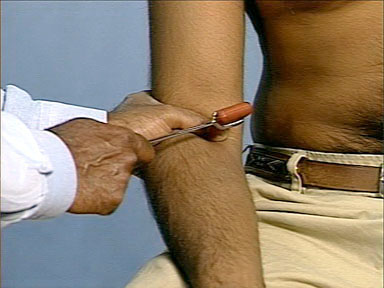
Biceps reflex: (C5-C6) With the arm gently flexed at the elbow, tap the biceps tendon with a reflex hammer. It may help to locate this tendon with your thumb, and strike your own thumb with the hammer. There should be a reflex contraction of the biceps brachii muscle (elbow flexion).
Triceps reflex: (C7-C8) With the elbow in flexion, tap the triceps tendon, just proximal to the elbow, with a reflex hammer. The arm could also be abducted at the shoulder for this maneuver. There should be a reflex contraction of the triceps muscle (elbow extension).
Brachiradialis reflex: (C5-C6)
Knee reflex: (L2-L4) Slightly lift up the leg under the knee, and tap the patellar tendon with a reflex hammer. There should be a reflex contraction of the quadriceps muscle (knee extension). (If performed in a sitting position, have the legs dangle over the edge of the chair or table).
Ankle reflex: (S1) Slightly externally rotate at the hip, and gently dorsiflex the foot, tapping the Achilles tendon with a reflex hammer. There should be a reflex contraction of the gastrocnemius muscle (plantar flexion).
When the reflexes are absent try eliciting it after re-enforcing (Jendrassik maneuver0, by asking the patient to interlock and pull flexed fingers.
Deep tendon reflexes should be graded on a scale of 0-4 as follows:
0 = absent despite reinforcement 
1 = present only with reinforcement
2 = normal
3 = increased but normal
4 = markedly hyperactive, with clonus


Heel to toe walking-

Compression of S1 S2 nerve roots make toe walking painful while that of L5 make heel walking painful.


Power of upper and lower limbs

·         Grade 0: No contraction or muscle movement
·         Grade 1: Trace of contraction, but no movement at the joint
·         Grade 2: Movement at the joint with gravity eliminated
·         Grade 3: Movement against gravity, but not against added resistance
·         Grade 4: Movement against external resistance, but less than normal
·         Grade 5: Normal strength


Modified Medical Research Council Scale for measuring hand muscles

Grade 5: full active range of motion & Normal muscle resistance
Grade 4: full active range of motion & Reduced muscle resistance
Grade 3: full active range of motion & No muscle resistance
Grade 2: Reduced active range of motion & No muscle resistance
Grade 1: No active range of motion & Palpable muscle contraction only
Grade 0: No active range of motion & No palpable muscle contraction